Monday, March 26, 2012

 End of Season Clearance Sale

Winter is almost over - well closer than it was last week - so we are offering sale prices for many Winter Items.

     This page will vary so check back often for new products.

Tuesday, March 20, 2012

Hydrotech Reverse Osmosis Water Filter 1240 "Pro"Systems                 
                            Clean Fresh Water for pennies a day!

Hydrotech Reverse Osmosis Systems (With Air Gap) 1240 Pro Series for 9, 15, 50 or 75 Gallons Per Day (GPD). The Hydrotech 1240 Pro model is equipped with a patented Smartap® Push Button Monitor. At the touch of a button you can be assured that you are receiving top quality water or you be alerted that it is time to change your membrane.
      No lugging heavy bottles, no cooler rental, no monthly bill, no hassle. For a typical family of four our drinking water system produces water at a cost of approximately $0.23 per day. Compare that to delivered bottled water at over $1.25 per day.

Our Hydrotech Reverse Osmosis System offer a more advanced treatment process than typical entry level pour-through pitchers or faucet filters. At the heart of the system is a reverse osmosis membrane which removes impurities as small as an atom! Additionally, your water passes through a series of sediment and carbon filters – eliminating any unwanted tastes and odors giving your water a polished, fresh taste!

The Hydrotech Reverse Osmosis System is a 4-Stage RO system which combines mechanical filtration with reverse osmosis technology for effective water filtration treatment in point-of-use applications.

The Hydrotech Reverse Osmosis System features a thin film composite membrane, a dual purpose sediment and activated pre-carbon filter, activated post-carbon filter, automatic shut-off, chrome standard faucet and a storage tank.

Hydrotech Reverse Osmosis Systems include 3/8” outlet tubing to the faucet for higher flows, quick connect fittings and color-coded tubing for easy installation and servicing. The Hydrotech 1240M Reverse Osmosis System can be neatly stored under the counter and provides you with clean, delicious Water Filtration right from its own dedicated tap 


     Hydrotech Reverse Osmosis 1240 Pro Features: 
  • High quality Reverse Osmosis Membrane
  • Smartap Push Button Monitor
  • Choice of 9, 25, 50 and 75 gallons per day
  • Sediment pre-filtration
  • Pre & post carbon block filtration
  • Quick connect fittings
  • Color coded tubing for ease of installation

Tuesday, March 13, 2012

                              Biasi RivaPlus Condensing Gas Boilers

Heat Only or With Domestic Water - Propane and Natural High Efficency Gas Boilers


  • 90% AFUE Condensing Gas Boiler  
  • Output Modulates 41,600 BTU to 103,000 BTU
  • Quiet and compact

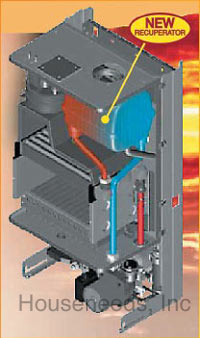
  • The RIVA Plus Boiler offers a unique condensing technology that increases the efficiency of the RIVA Compact and Combi Boilers to 90% AFUE. With the inclusion of a recuperator, the RIVA Plus can extract the remaining heat from the boiler's exhaust gas and transfer that heat into the return water destined for the boiler's primary heat exchanger. The recuperator guarantees higher efficiency and set-up simplicity. RIVA Plus is the only condensing wall-mounted boiler to offer this technology.


     The RIVA Plus Combi version is equipped with a flat      plate heat exchanger which heats your domestic water whenever you open the hot water taps. The high efficiency design eliminates all the standby losses associated with storage tank water heaters.

    Both RIVA Plus Combi and Compact Boilers maintain a constant high efficiency in both high and low temperature heating systems. Utilizing Biasi's Concept panel radiators, which heat at low water temperatures, will further increase efficiency by decreasing the average temperature of your heating system. For homeowners, Biasi RIVA boilers are not only quiet, dependable and efficient, they are more attractive and require less space than conventional boilers. And there is comfort in knowing that the sealed combustion heat exchanger provides the ultimate in safety while providing efficient central heating boiler and economical hot water supply with the Riba Plus Combi Model.
             Biasi RivaPlus Insides

    Click on link below to search by Boiler Type:

    Combi Boilers: view all Combi Gas Boilers & Combi Propane Boilers

    Combination Boilers: view all Combination Gas Boilers & Combination Propane Boilers

    Condensing Boilers: view all Condensing Gas Boilers & Condensing Propane Boilers

    Non Condensing Boilers: view all Non Condensing Gas Hot Water Boilers

    Oil Fired Boilers: view all Oil Heating Boilers & Oil Boiler

    Electric Boilers: view all Electrical Heating Boilers


    Wednesday, February 22, 2012

    Heating University / Learning Center

    Would you like to learn how to install a heating system?
    Feel like you need to buy a Book on Heating Systems for Dummies?
    Save your money and go to our LEARNING CENTER for
    Educational Links and Information
    The links show examples of Solar Heating, Hydronic Heating Systems, Hot Water Heating Systems, PEX Tubing Layouts, PEX Radiant Heating Systems, Underfloor Radiant Heat, Slab Radiant Heat, Hot Water Boilers Configurations and more. These are just examples. Actual layouts vary from job to job. Always follow manufacturers instructions.
    How to "Heating Systems"
    How to "PEX Radiant Heating Systems"
    How to "Solar Water Heating"
    How to "Water Heating Systems"
    How to "Plumbing Pex Systems"

    For custom quotes please proceed to the link below...
    http://www.houseneeds.com/shop/heatingproducts/radiantheating/radiantheatpackagestep1.asp

    Wednesday, August 3, 2011

    Order Bosch Parts On-Line and Save...

    Houseneeds only does the fulfillment for Bosch. They package all parts. And only a Bosch tech can confirm part numbers.

    Link to Search (just put part number in the search box):
    http://www.houseneeds.com/search.asp

    Link to Page:
    http://www.houseneeds.com/shop/Heatingproducts/waterheating/parts/waterheaterrepairparts.asp

    Monday, June 27, 2011

    Whats New from Houseneeds

    Remember, Houseneeds is always on the lookout for new products that are energy efficient or make those household projects easier to tackle.

    Link to Whats New:
    http://www.houseneeds.com/whatsnew.asp

    Monday, June 13, 2011

    Did You Know...

    HousePex's molecular orientation is achieved during extrusion, which is a very unique process. Peroxide cross-linking occurs simultaneously with the orientation and guarantees optimal tubing properties (pex stands for polyethylene cross-linked).

    EVOH - Refers to a type of oxygen barrier that is commonly used in Pex Tubing. EVOH stands for ethylene vinyl alcohol, this compound prevents oxygen diffusion and is bonded to the Pex during the manufacturing process.

    HousePex is Manufactured in Sweden on state-of-the-art
    extruding machines, uses Peroxide Extrusion which is the most
    flexible / strongest and meets SDR-9 specification (standard dimensional ratio).

    Tuesday, May 31, 2011

    Whole House Fan Basics

    On a sunny day the temperature of an attic can reach as high as 140 degrees! And this high temperature in your attic will keep the indoor temperature higher than the outdoor temperature for several (or more) hours after the sun goes down.

    By pulling heat out of your home with the a Whole House Fan, cooler outside air is drawn into the home. The heated air is then pushed out of your home through the attic vents. WHF's can make you more comfortable and could reduce your air conditioning bills.

    When you choose a fan, divide that fans cfm by 750 (1 square foot of opening for each 750 cfm (cubic feet per minute) of airflow). This number determines the amount of square footage of net free air required to properly vent. To allow for any restrictions created by screening and louvers multiply that number by 2. This number is the minimum square footage of venting required for the fan to exhaust properly. One can choose a combination of ridge, soffit and/or gable venting to make up the square footage.

    Tuesday, May 17, 2011

    The benefits of a PEX Radiant Heat System:

    Comfort - It may be freezing outside, but your pex radiant heat system will keep you warm from head to toe. Nothing compares to the comfort and surrounding warmth of a pex underfloor radiant heat system in your home using our PEX Tubing. We have PEX-A, PEX-C and Alum PEX Tubing.


    Efficiency - Radiant Heat with PEX is the most efficient heating system available. Radiant underfloor heat costs less to heat your home than any other type of heating system by being able to lower the thermostat temperture while still staying toasty warm. Generally, you can save 15 to 20% as compared to forced-air or hydronic baseboard heating systems.


    Zoning - With pex radiant heat, you can zone different areas of your home to different temperatures to fit your lifestyle, unlike central heating and air.


    Flexibility - A radiant floor heating system can be installed under practically any type of flooring, such as carpeting, tile, linoleum, wood floors, etc. Easily add underfloor heat to small areas such as bathrooms or kitchens.


    Improves Air Quality - PEX Radiant Heat reduces dust mites and air borne allergens by 60%-90%. No other heating system reduces allergies as effectively as radiant heat.


    Interior Decorating Freedom - PEX Radiant heat systems are installed with PEX Tubing and is within the structure of your home, which means you will not have to consider vents, hydronic baseboards, hydronic radiators, or drafty areas when decorating and furnishing your home.


    Adds Value to Your Home - There are many other potential implementations of pex radiant heat in your home such as heating your garage or melting snow from your driveway in winter. A radiant heating system will increase the value of your home more than it costs to install.

    Wednesday, May 11, 2011

    Surge Suppressor and Power Conditioning Systems

    On residential units we emphasize the PowerGUARD’s ability to protect the whole house. In fact, the PowerGUARD is ETL listed for spike and surge suppression. A common misconception is that the PG is capacitor driven. It is a magnetic choke based system that improves Power Factor inductively. Along with the energy savings, the power quality is improved (better balanced voltage, reduced amperage and spike / surge protection)which is far more than a capacitor can offer.

    With all the heat pump and HVAC applications in the southern part of the country, there is ample opportunity for energy savings for the average homeowner. Some solar installers include a PowerGUARD unit in each application as it protects the Photo Voltaic system from spikes, surges and helps the system last longer as well as reducing total usage for the homeowner.

    Tuesday, May 3, 2011

    Did You Know

    The earth has a much more constant temperature than the air. It might be 100 degrees in summer and -40 degrees in winter where you live. But a few feet down, the earth will always be a steady temperature.

    For every 100 feet you go down into the earth, the temperature rises 1.5 degrees. So if you were to dig down to a depth of 600 feet, assuming the temperature a few feet below ground is 60 degrees, the deeper rock would have a temperature of
    69 degrees.

    Wednesday, April 27, 2011

    Boiling Temperature of Water At Different Altitudes

    Approximate Boiling Temperatures of Water

    Altitude........Temperature
    Sea Level.......212 degrees F
    984 ft............210 degrees F
    2,000 ft........208 degrees F
    3,000 ft........206 degrees F
    5,000 ft........203 degrees F
    7,500 ft........198 degrees F
    10,000 ft.......194 degrees F
    20,000 ft.......178 degrees F
    26,000 ft.......168 degrees F

    Note: Each 500 foot increase in altitude causes a drop of about 1° in the boiling point.

    Boiling Temperature Of Water At Different Altitudes

    Approximate Boiling Temperatures of Water

    Altitude TemperatureSea Level 212 degrees F
    984 ft. 210 degrees F
    2,000 ft. 208 degrees F
    3,000 ft. 206 degrees F
    5,000 ft. 203 degrees F
    7,500 ft. 198 degrees F
    10,000 ft. 194 degrees F
    20,000 ft. 178 degrees F
    26,000 ft. 168 degrees F

    Note: Each 500 foot increase in altitude causes a drop of about 1° in the boiling point.

    Wednesday, April 20, 2011

    Home Energy Conservation and Tips

    Saving energy means more dollars in your pocket, but it is also a powerful way to save our valuable resources. Energy conservation is the most important green initiative that we should take to heart and practice.

    We can start with small steps to lighten the "footprints" we leave behind for future generations like the simple changing of a light bulb which can make a dramatic difference in energy efficiency and cost savings (standard incandescent light bulbs with compact fluorescent light bulbs (CFLs) can save 75% of lighting cost).

    A surprisingly large number of electrical products—TVs to microwave ovens to air conditioners—cannot be switched off completely without being unplugged. These products draw power 24 hours a day, often without the knowledge of the consumer. We call this power consumption "standby power."

    An individual product draws relatively little standby power but a typical American home has forty products constantly drawing power. Together these amount to almost 10% of residential electricity use.

    Identify and reduce these energy drains by using smart strips or unplugging when not in use.


    Energy Saving Tips

    Turn off the lights when you leave a room.

    Replace energy-hungry incandescent lights with fluorescent lighting.

    Check with your utility company for energy conservation tips.

    Use a programmable thermostat that automatically turns off

    the air conditioner or heater when you don't need them.

    Add insulation to your home.

    Use a fan instead of air conditioning.

    Use an EPA-approved wood burning stove or fireplace insert

    Insulate your water heater or buy a tankless unit.

    Install low-flow showerheads.

    Tuesday, April 12, 2011

    Solar Collectors

    EVACUATED TUBE COLLECTORS:
    Another type of active solar collector consists of several
    glass tubes, each of which has concentric inner and outer
    walls. The annular space between these glass tubes has
    been evacuated of air and thus acts like a Thermos®
    bottle. Convective heat transfer between the inner and
    outer glass tubes is essentially eliminated. A coated
    copper absorber strip with attached tubing is located
    within the inner glass tube, as shown in figure 12.
    Most current-generation evacuated tubes have a
    specialized fluid sealed within the internal copper tubing.
    When heated, this fluid changes from liquid to vapor
    and rises toward the top of the tube. It then passes into
    a small copper capsule that fits tightly into a manifold
    assembly at the top of the collector. Heat conducts
    though this copper capsule into fluid circulating along
    the manifold. The fluid sealed within the evacuated
    tubes never contacts the fluid in the manifold. As heat
    is released from the fluid within the evacuated tube, it
    condenses back to a liquid and flows back to the bottom
    of the tube ready to repeat the cycle.


    FLAT PLATE COLLECTORS:
    The principal component in this type of collector is the
    absorber plate, which is usually an assembly of copper
    sheet and copper tubing. The top surface of the absorber
    plate is coated with dark colored paint or electroplated
    “selective surface” coating that absorbs the vast majority
    of solar radiation striking it. The instant solar radiation
    strikes this surface it is converted to thermal energy
    (e.g., heat). The copper sheet acts as a wick to conduct
    this heat toward the copper tubing that is welded or
    otherwise bonded to the sheet. Heat moves across the
    copper sheet toward the tubes because the fluid flowing
    through the tubes is cooler than the absorber sheet. This
    fluid absorbs the heat and carries it out of the collector.
    To minimize heat loss, the absorber plate is usually
    housed in an enclosure made of aluminum and capable of
    withstanding many years of exterior exposure. The sides
    and back of this enclosure are insulated with materials
    capable of withstanding temperatures in excess of 350ºF,
    which might occur if the collector is exposed to intense
    sunlight without fluid flow through its absorber plate.
    The upper surface of the enclosure is usually tempered
    glass with a low iron oxide content. Tempered glass can
    withstand high thermal stress as well as potential impact
    from hailstones or other objects. Low iron oxide content
    glass minimizes absorption of solar radiation as it passes
    through on its way to the absorber plate.

    Tuesday, March 29, 2011

    Types of Venting

    A Type - Double Wall, Stainless and Insulated between walls

    B Type – Double Wall, Air between walls (Galvanized outer - Aluminum inner)

    C Type – Single Wall Stainless (Z-Vent)

    Wednesday, March 23, 2011

    Roof Pitch by Degrees

    Roof Pitch and the corresponding degrees:
    12/1 = 4 degrees
    12/2 = 9.5
    12/3 = 14
    12/4 = 18.5
    12/5 = 22.5
    12/6 = 26.5
    12/7 = 30.5
    12/8 = 33.75
    12/9 = 37
    12/10 = 40
    12/11 = 42.5
    12/12 = 45

    Tuesday, March 8, 2011

    High Altitude NG Or LP Ratings

    For operation at elevations above 2000 feet, the equipment ratings (NG or LP gas) shall be reduced 4% for each 1000 feet above 2000 feet.

    From 4000 to 10,000 feet a CO2 adjustment with a flue gas analyzer should be used for all gas appliances.

    Tuesday, February 22, 2011

    Common Plumbing Terms

    AGA - American Gas Association
    CC - Copper x Copper
    NPT - National Pipe Thread (Standard)
    Dia.- Diameter
    FGH - Female Garden Hose
    FHT - Female Hose Thread
    FIP - Female Iron Pipe
    FPT - Female Pipe Thread
    IPS - Iron Pipe Size
    MGH - Male Garden Hose
    MHT - Male Hose Thread
    MIP - Male Iron Pipe
    MPT - Male Pipe Thread
    GPM - Gallons Per Minute
    OD - Outside Diameter
    ID - Inside Diameter
    SWT - Sweat
    THD - Thread
    CP - Chrome Plated
    PB - Polished Brass
    SF - Satin Finish
    SS - Stainless Steel

    Thursday, February 17, 2011

    Sizing An Electric Tankless Water Heater

    When sizing an electric tankless water heater for your home remember to look at the manufactures recommended electric service to the house (in Amperage) for each model you are considering. A common mistake when ordering online is to look at the 220/240 Volts and not the Amperage, often resulting in getting the wrong size and the wasted time of a return.

    Our electric tankless water heaters are 97% efficient and are not subject to stand-by losses of conventional tank type water heaters.
    This offers a 20% or more savings on the hot water portion of your bill.